

Napa Valley's vineyards are changing into their spectacular fall colors. While most of that transformation is seasonal, red leaves can also provide clues about vine health- including a disease receiving increasing attention from Napa growers: red blotch.
By Peter Ekman – October 26, 2026

Every October, Napa Valley begins to change color.
After harvest, green vineyards turn shades of yellow, orange, red and deep purple. It is one of the most beautiful times of year in wine country.
Most of this is simply nature at work as the vines prepare for winter. But when I see a vineyard turning brilliant red, I increasingly find myself asking another question:
What is the vineyard telling us?
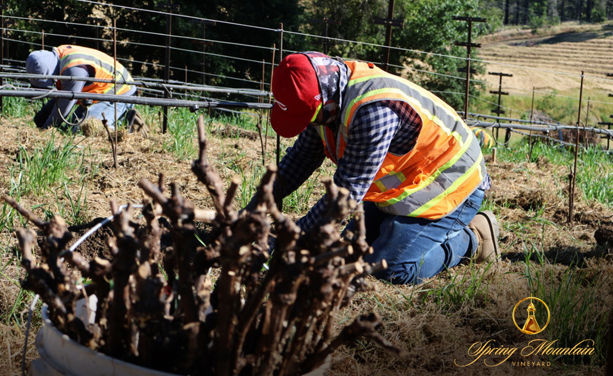
At Spring Mountain Vineyard, where we are in the middle of replanting 225 acres, this question is particularly relevant. Vineyard health, clean planting material and long-term disease prevention are important considerations as we establish vineyards intended to thrive for generations.
One reason is a disease called Grapevine Red Blotch.
What is red blotch?
Red blotch is a viral disease that can interfere with a grapevine's ability to ripen fruit normally.
In red varieties such as Cabernet Sauvignon, infected vines can develop irregular red or purple are as on their leaves. But appearance alone cannot diagnose the disease. Normal seasonal change, nutrient deficiencies, water stress, leafroll and other vineyard conditions can produce similar symptoms.
Testing is needed to know for certain.
Once a vine is infected, there is currently no cure. Research has associated red blotch with delayed ripening, lower sugar accumulation and changes in grape development - the reason growers and researchers are paying increasing attention to it.

How significant is it in Napa Valley?
We don't really know.
There is no reliable estimate of how much Napa Valley vineyard acreage is infected with red blotch, and a red vineyard should never be assumed to be infected simply because of its color.
What we do know is that the issue is receiving serious attention.
UC Cooperative Extension has monitored red blotch and its insect vectors across 31 vineyard blocks in 12 Napa Valley AVAs. Napa Valley Grapegrowers devoted its 2024 ROOTSTOCK conference to the subject and continues to support research and education around vineyard health.
Researchers have also learned considerably more about how the virus spreads. Infected planting material is one route, and the three-cornered alfalfa hopper has been confirmed as an insect capable of transmitting the virus between vines.
Perhaps most encouragingly, our ability to identify and manage vineyard-health risks continues to improve. Better testing, cleaner planting material, vineyard monitoring and emerging detection technologies are giving growers more information with which to make decisions.
Why does this matter now?
Napa Valley is in the midst of an important vineyard transition.
Many vineyards planted decades ago are reaching an age when growers must decide whether to continue farming them or begin again. At the same time, changing wine demand and vineyard economics are accelerating some of those decisions.
Vine health is becoming another part of that conversation.
For those of us planting vineyards today, the objective isn't simply to plant the right variety, clone and rootstock in the right place. It is also to give those vines the healthiest possible start and protect that health over what we hope will be many decades.
So this fall, as Napa Valley turns its spectacular shades of red and purple, enjoy the view.
Most of what we see is simply the changing of the season.
But the leaves can also tell us something about the health of the vineyard beneath them - and increasingly, Napa growers are learning how to listen.